

A Company Everyone Had Written Off Now Back in the Spotlight
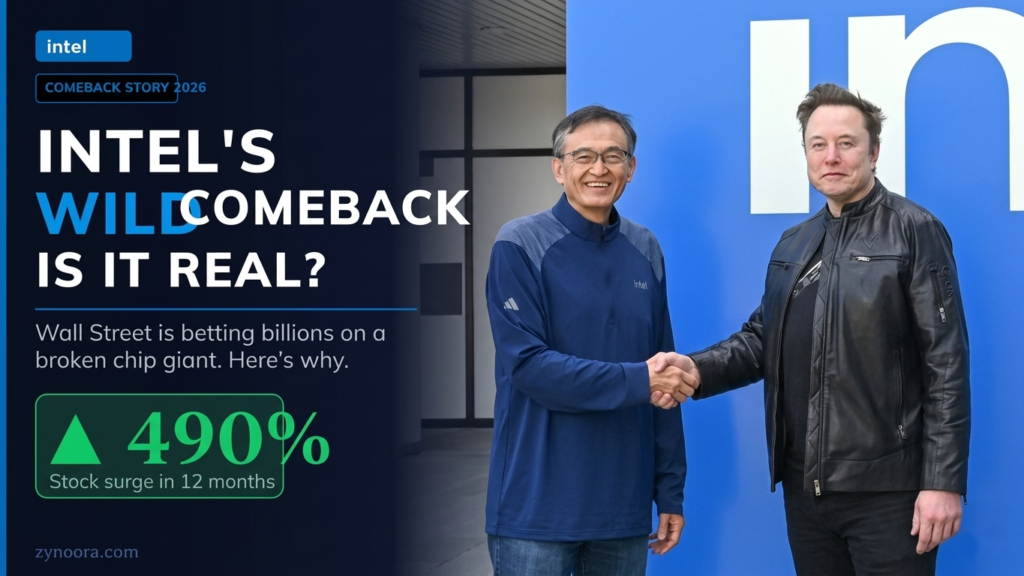
Not long ago, Intel was the tech story nobody wanted to talk about at least not in a good way.
The chip giant had been losing ground for years. TSMC had lapped it on manufacturing. Nvidia was printing money on AI chips. And Intel? Intel was stuck in a loop of missed timelines and shrinking market confidence.
Then something shifted. The stock has climbed almost 490% over the past year, and Wall Street is suddenly treating Intel like it matters again. The question worth asking: is this a genuine Intel comeback in 2026, or is the market getting way ahead of itself?
Let’s break down what’s actually going on.
The Man Who Changed Investor Sentiment Overnight
When Lip-Bu Tan stepped into the CEO role last March, the tech industry took notice immediately and not just out of courtesy.
Tan isn’t a professional turnaround artist who floats from company to company. He has spent decades inside the semiconductor world, building real relationships with manufacturers, AI labs, and government stakeholders. That context matters enormously in a business as relationship-dependent as chip-making.
His approach in the first year wasn’t the dramatic restructuring playbook you might expect. Instead, he focused on quietly rebuilding trust with partners, with governments, and with investors who had spent years watching Intel stumble.
It’s a slower strategy. But it’s clearly working on the perception front, which in markets is half the battle.
Intel’s Real Edge Right Now Has Nothing to Do With Transistors
The Geopolitical Card Is Stronger Than Any Product Launch
Here’s the honest reality: Intel’s manufacturing still has meaningful gaps compared to TSMC. Yield rates on advanced nodes are reportedly still catching up, and internal teams have faced their share of deadline slippage. That’s not a minor footnote that’s the core of the business.
And yet investors keep buying.
The reason is simple, even if it sounds strange: Intel has become politically important in a way that changes the entire risk calculation.
Semiconductors are no longer just a technology product. They’re infrastructure. Governments especially the U.S. now treat chip manufacturing as a national security issue. Intel reportedly locked in a major partnership with the U.S. government, which has effectively become one of its largest stakeholders.
That safety net is almost impossible to put a price on. When a company is intertwined with national infrastructure priorities, the traditional rules around failure get quietly rewritten.
Apple and Tesla in the Picture? That Changes Everything
There’s another layer to this story that’s been driving the optimism.
Reports have surfaced about Intel exploring manufacturing relationships with Apple and Tesla. Even early-stage conversations with companies of that scale carry serious weight.
Think about what that narrative shift looks like from an investor’s chair. The question stops being ‘can Intel survive?’ and becomes ‘what if Intel ends up as a critical link in America’s AI supply chain?’
That’s a completely different company story. And markets price stories, not just spreadsheets.
| The Key Insight Intel’s stock surge isn’t a reward for problems already solved. It’s a bet on Intel becoming too strategically important to the AI era for the market or the government to let fail. That’s a very different kind of investment thesis. |
The Risk That Nobody Wants to Say Out Loud
A 490% stock surge creates a brutal expectation problem.
Chip manufacturing doesn’t scale the way software does. You can’t ship a firmware update to fix a fab. Building world-class semiconductor factories is a years-long, capital-intensive grind and actually hitting consistent, high-quality yields at advanced nodes is something only TSMC has truly mastered at scale.
Intel has the roadmap. It has the funding. It has the political backing. What it still needs is execution and execution at this level takes time that impatient markets don’t always give.
At some point, the enthusiasm needs receipts. And that moment is getting closer.
Why the Broader Picture Still Favors Intel’s Bet
Even with all the risks on the table, it’s hard to ignore the structural tailwinds Intel is sitting on.
Five years ago, most tech investors treated semiconductors as just another sector. Now every major government wants domestic chip production. Every major AI company wants supply chain redundancy. And every geopolitical flashpoint reminds the world that depending entirely on fabs in East Asia carries real risk.
Intel is positioned imperfectly, but genuinely at the intersection of all three of those trends. That’s not nothing. In fact, for a company that seemed nearly irrelevant two years ago, it’s quite a lot.
Quick Verdict
| Category | Verdict |
| Stock Momentum | Extremely strong nearly 490% over the past year |
| Manufacturing Strength | Still trailing TSMC on advanced node yields |
| AI Positioning | Improving fast, partnerships are accelerating |
| Leadership Confidence | High Lip-Bu Tan has strong industry credibility |
| Risk Level | Very high valuation runs ahead of execution |
| Long-Term Potential | Massive, if the factory output actually catches up |
Final Thoughts
The Intel comeback story in 2026 is real but it’s real in a specific, conditional way.
This isn’t a story about Intel having already fixed its problems. It’s about Intel positioning itself as something the AI era can’t afford to leave behind. That’s a much harder thesis to value, but it’s also a far more interesting one.
If Lip-Bu Tan’s quiet alliance-building pays off and the fabs start delivering, this could end up being one of the more remarkable corporate revivals in tech history.
But if the execution keeps slipping while the stock keeps climbing, the gap between narrative and reality is going to close and not in a pleasant way.
For now, Intel sits somewhere between redemption story and high-stakes gamble. And honestly, that tension is exactly what makes it worth watching.
Written by Saad · zynoora.com