 Saad Rahim
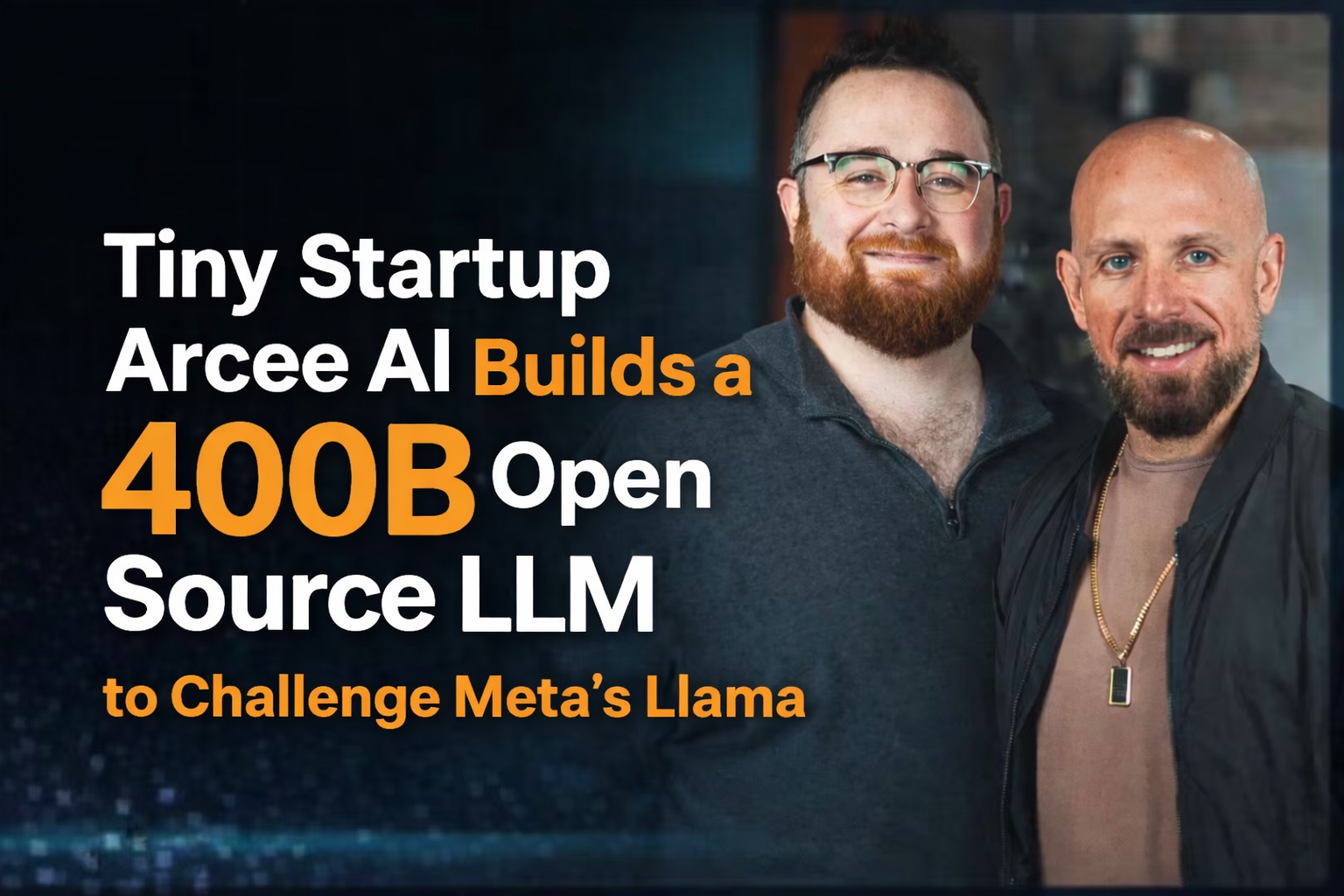
 For years, the artificial intelligence world has believed that only Big Tech could dominate the foundation model race. Companies like Google, Meta, Microsoft, and OpenAI seemed untouchable, backed by massive budgets and global infrastructure. But a small thirty-person startup called Arcee AI has just challenged that assumption in a very serious way.
Arcee AI has officially released Trinity, a 400 billion parameter open source large language model built from scratch under an Apache license. This makes it one of the largest truly open foundation models ever developed by a U.S. company. More importantly, it is permanently open, with no future restrictions or commercial limitations.
At a time when openness in AI is slowly shrinking, Trinity represents a bold return to transparent and accessible model development.
Why Trinity Matters in the AI Industry
Many open models today are open in name only. Some come with licenses that restrict usage, deployment, or modification. Meta’s Llama models, while extremely powerful, use a license that is controlled by Meta itself and includes specific limitations.
Arcee AI took a different path.
By choosing the Apache open source license, the company guarantees that Trinity will remain fully open forever. Developers, researchers, and enterprises can use it freely without worrying about future lock-ins or sudden license changes.
According to Arcee AI’s leadership, winning the AI model market is not just about size or marketing. It is about trust, openness, and performance.
Benchmark Performance Against Llama and GLM Models
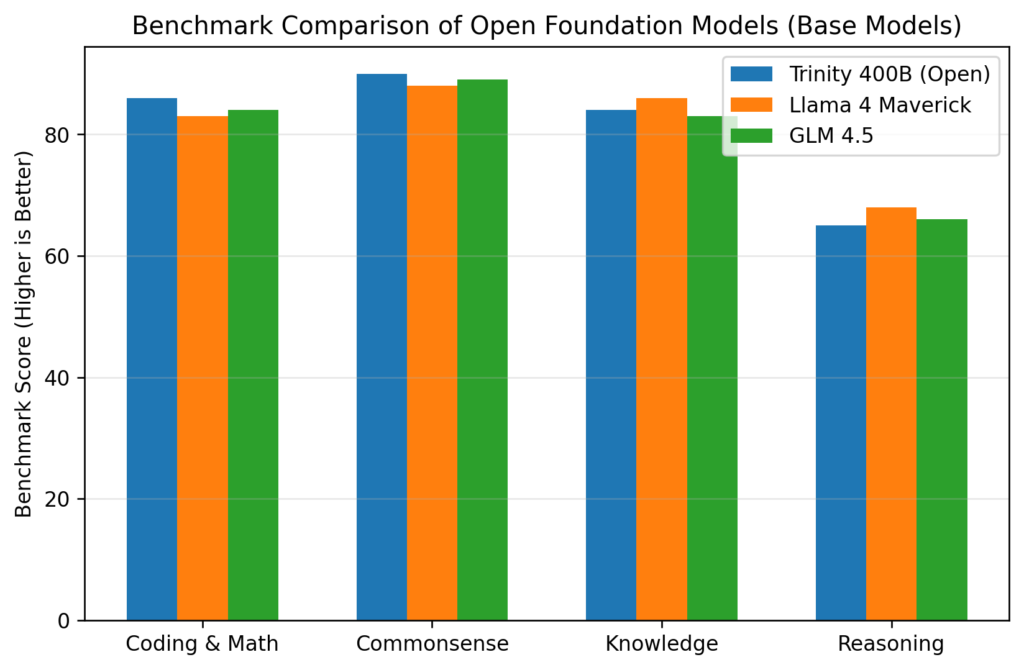
Trinity is currently released as a base model preview with minimal post-training. Even at this early stage, benchmark results show impressive performance across multiple categories.
Arcee AI reports that Trinity holds its ground and in some areas slightly outperforms Meta’s Llama 4 Maverick and Z.ai’s GLM 4.5 in tasks related to coding, mathematics, reasoning, and general knowledge.
Below is a simplified benchmark comparison chart created specifically for this article to visualize overall performance trends.
🖼️ Benchmark Chart:
You can upload this image directly into WordPress without copyright risk.
Built for Developers and Researchers First
Unlike many commercial models optimized mainly for chatbots, Trinity is designed with developers and academics in mind. The focus is on coding workflows, agentic reasoning, and multi-step problem solving rather than flashy consumer features.
Currently, Trinity supports text only. However, Arcee AI has already confirmed that a vision model is under development, and a speech-to-text system is planned for the near future.
Meta’s Llama already supports multimodal input, but Arcee intentionally chose to perfect the base model first before expanding into additional modes.
Training a 400B Model With a Startup Budget
One of the most surprising aspects of Trinity is how efficiently it was created.
Arcee AI trained all its models in just six months using 2,048 Nvidia Blackwell B300 GPUs. The total cost was approximately 20 million dollars, funded from the roughly 50 million the company has raised so far.
In a world where major AI labs spend billions on single models, this achievement stands out as a masterclass in focused execution.
According to CTO Lucas Atkins, the timeline was aggressive but intentional. The team consisted of young, highly motivated researchers who worked long hours under immense pressure to deliver something extraordinary.
From Model Customization to Building a Frontier LLM
Arcee AI did not originally plan to become a full-scale AI lab.
The company started by post-training and customizing existing open models such as Llama, Mistral, and Qwen for enterprise clients like SK Telecom. Over time, dependency on external models became a strategic risk, especially as many leading open models originated from China.
For U.S. enterprises concerned about regulation, geopolitics, and data trust, this created a major gap in the market.
That gap is exactly where Trinity was born.
A True Open Source Alternative for the United States
Arcee AI’s leadership believes the U.S. needs more than one open foundation model. Relying on a single company or a single license structure creates fragility.
Trinity aims to be a frontier-grade, permanently open alternative that enterprises can rely on long term. Unlike models with conditional openness, Trinity’s license guarantees freedom for research, customization, and commercial use.
All Trinity models are available for free download, including Trinity Nano at 6B parameters, Trinity Mini at 26B parameters, and Trinity Large at 400B parameters.
API Access and Future Plans
Arcee AI plans to release a hosted API version of Trinity within the next six weeks, with pricing designed to remain competitive.
Current API pricing for Trinity Mini starts at affordable rates and includes a free tier. The company also continues to offer post-training and customization services for enterprises that need tailored solutions.
As reasoning training improves and multimodal capabilities arrive, Trinity could become one of the most important open AI projects in the world.
Final Thoughts
Arcee AI’s Trinity proves that innovation in AI is not limited to trillion-dollar giants. With focus, talent, and a commitment to openness, even a small team can challenge the biggest names in the industry.
In an era where truly open AI is becoming rare, Trinity is more than a model. It is a statement.