 Saad Rahim
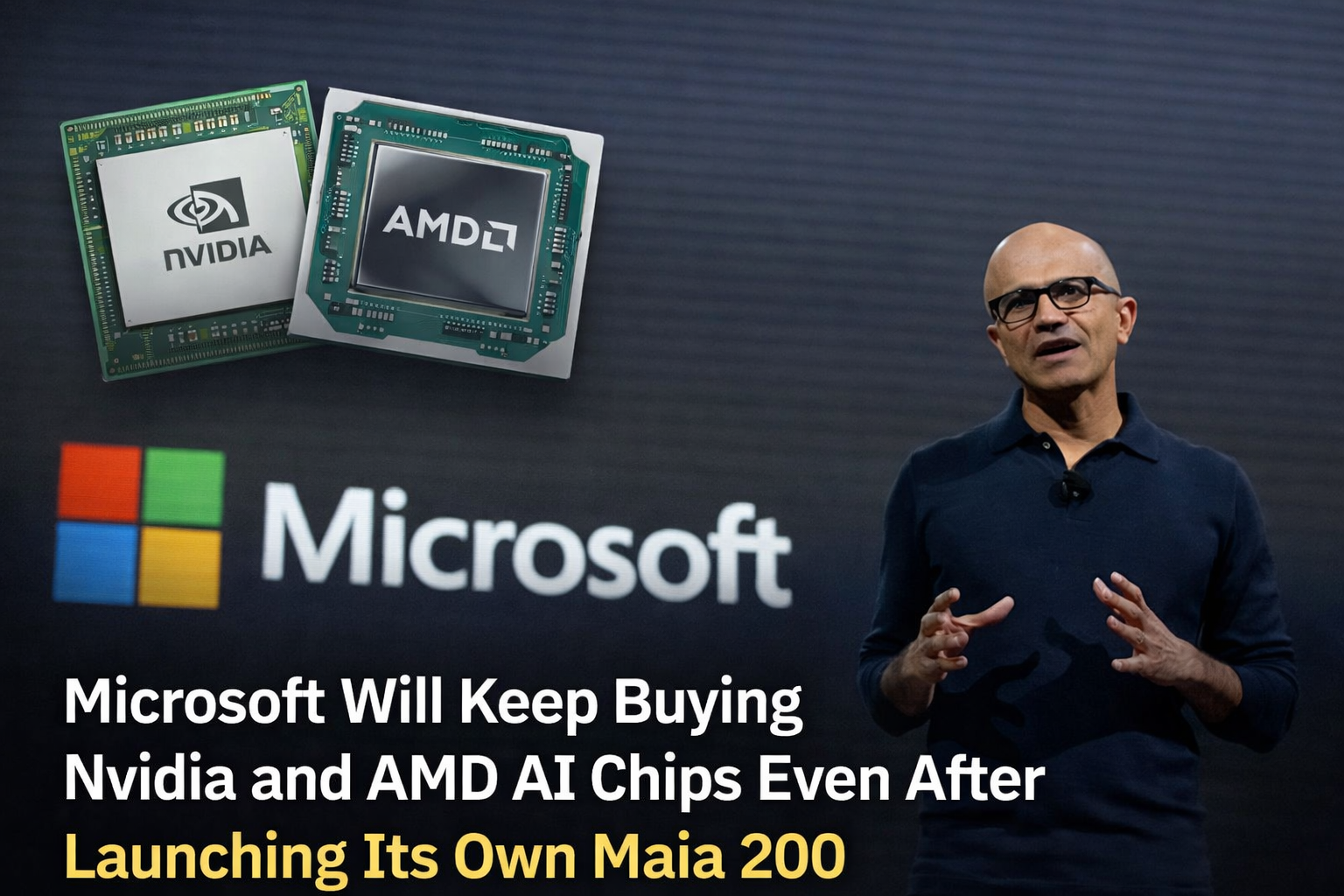
 Microsoft has finally done what every cloud giant was expected to do sooner or later. It has launched its own in house AI chip. And yet, surprisingly or maybe not, the company has no plans to walk away from Nvidia or AMD.
This week, Microsoft quietly deployed its first batch of homegrown AI chips inside one of its data centers. More rollouts are already planned for the coming months. The chip is called Maia 200, and on paper, it is anything but modest.
But here’s the part that really matters. Even after building a powerful AI processor of its own, Microsoft says it will continue buying chips from Nvidia and AMD. That alone tells you a lot about how intense the AI hardware race has become.
What Makes the Maia 200 Important
Microsoft describes Maia 200 as an AI inference powerhouse. In simple words, it is built for running AI models at scale, not just training them in labs. This is the kind of work that happens once AI models are deployed into real products, cloud services, and enterprise tools.
According to Microsoft’s own performance claims, Maia 200 outperforms Amazon’s latest Trainium chips and Google’s newest Tensor Processing Units. That is a bold statement, and it places Microsoft right alongside the biggest players designing custom silicon for artificial intelligence.
This move is not about showing off. It is about control. AI workloads are exploding, and relying entirely on external suppliers is risky.
Why Microsoft Still Needs Nvidia and AMD
If Microsoft has such a strong chip, why keep buying from others?
Satya Nadella gave a very honest answer. Microsoft has deep partnerships with Nvidia and AMD, and those companies are still innovating at a speed that is hard to ignore.
The AI chip market is facing a serious supply crunch. Nvidia’s most advanced GPUs are expensive, scarce, and in constant demand. Even companies with massive budgets cannot always get what they want, when they want it.
Building your own chip helps. But it does not magically solve shortages or replace an entire ecosystem overnight.
Nadella made it clear that vertical integration does not mean isolation. Just because Microsoft can build its own stack does not mean it should abandon everything else.
And that mindset feels realistic.
A Long Game, Not a One Time Win
What stood out most in Nadella’s comments was his focus on time. Being ahead in AI is not about a single launch or benchmark. You have to stay ahead consistently, year after year.
Relying on multiple hardware partners gives Microsoft flexibility. It reduces risk. And it ensures that Azure customers are not limited to one type of silicon.
This is not a rivalry story. It is a survival strategy.
Who Gets Maia 200 First
The first team to use Maia 200 will be Microsoft’s Superintelligence group. This is the internal team working on the company’s most advanced AI models, often referred to as frontier models.
The group is led by Mustafa Suleyman, the former Google DeepMind co founder. According to Suleyman, his team gets early access to Maia 200 as they push forward on Microsoft’s next generation AI systems.
He even shared the moment on X, calling the launch a big day and confirming that his team would be the first to put the chip to real use.
That detail matters because it shows how valuable AI hardware has become, even inside the same company.
Maia 200 and OpenAI on Azure
Microsoft also confirmed that Maia 200 will support OpenAI models running on Azure. That strengthens Azure’s position as one of the most important platforms for AI development and deployment today.
At the same time, Microsoft is clearly thinking beyond OpenAI. The company is investing in its own AI models, with the long term goal of reducing reliance on outside model makers like OpenAI and Anthropic.
This is not about cutting ties. It is about having options.
The Real Problem Still Isn’t Solved
Even with Maia 200 in play, access to the most advanced AI hardware remains difficult. Customers want more compute. Internal teams want priority. And supply is still limited.
That is the reality for everyone right now.
This is exactly why Microsoft is keeping its relationships with Nvidia and AMD intact. No single chip, no matter how powerful, is enough on its own.
Final Thoughts
Microsoft’s decision to keep buying AI chips from Nvidia and AMD even after launching Maia 200 is not a contradiction. It is a signal.
AI at scale is too important to depend on one path alone. By combining its own silicon with best in class third party hardware, Microsoft is building a more resilient AI future.
Maia 200 is a strong step forward. But the real strategy is balance, flexibility, and thinking long term.